
Is a Scoliosis Intensive Program Just Chiropractic? What Parents Should Know Before Choosing Any Non-Surgical Scoliosis Treatment
When parents hear about a scoliosis intensive program, one of the first questions they ask is simple: “Is this just chiropractic?”
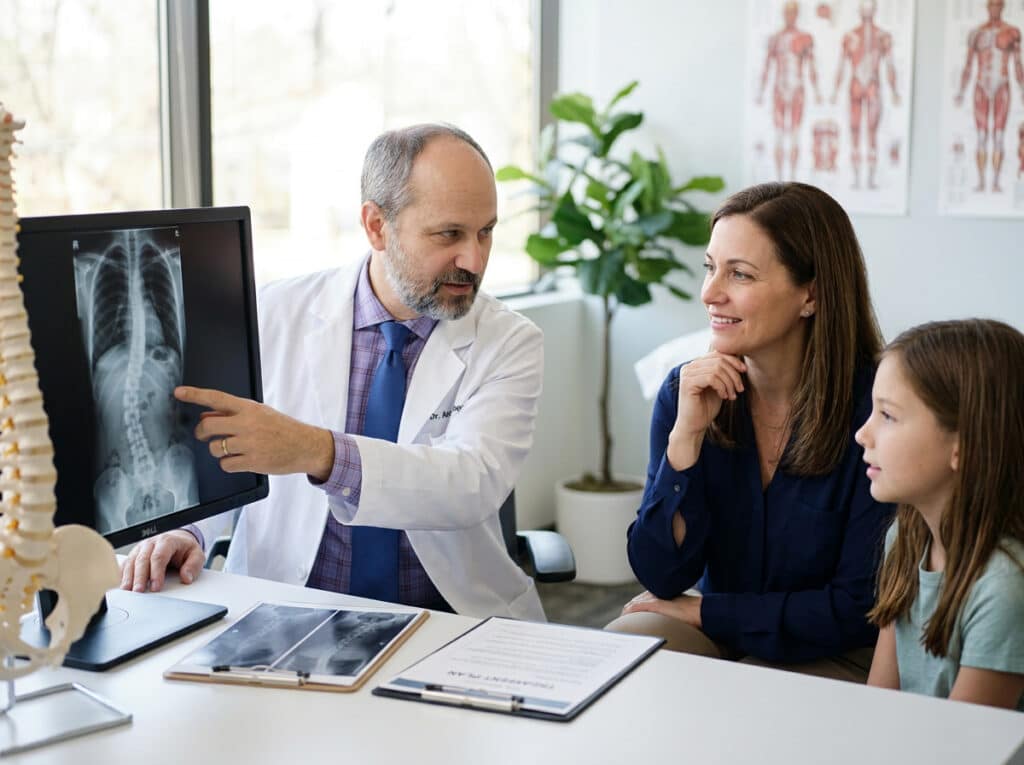
That is a fair question. Many families are already doing the hard work of scoliosis care. Their child may be seeing an orthopedist, wearing a brace, attending physical therapy, and following a home exercise plan. If someone then recommends a two-week intensive rehabilitation program, skepticism is understandable.
The truth is that not all scoliosis programs are the same, and care offered by a chiropractor trained in scoliosis specific care is NOT the same as a routine chiropractic adjustment.
A scoliosis intensive should be judged by what it actually includes, how clearly it explains its goals, how well it coordinates with medical monitoring, and whether it gives families realistic expectations.
The short answer
A scoliosis intensive program is not automatically the same thing as standard chiropractic treatment.
Our scoliosis intensives are built around:
- scoliosis-specific corrective exercise designed for home use
- posture retraining
breathing mechanics - curve-specific positioning called Active Self Correction
- neuromuscular re-education to retrain postural mechanisms
- home integration for daily life, known as Activities of Daily Living
That is different from the public stereotype of chiropractic as occasional spinal “cracking” or generalized adjustment.
The real question is not the professional label alone. The real question is:
What is the treatment model, what are the goals, and how is success measured?
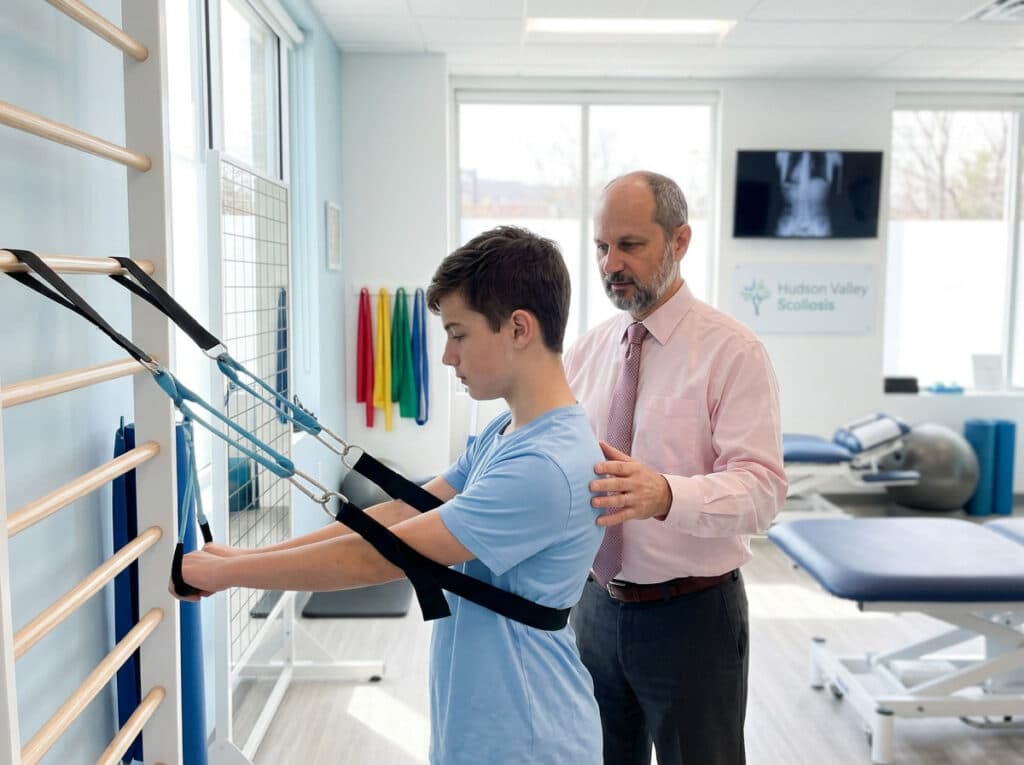
What is a scoliosis intensive program?
A scoliosis intensive is a concentrated rehabilitation program delivered over a short period, often one to two weeks, with up to 5 hours of daily supervised work.
The purpose is usually to teach the patient and family how to apply curve-specific corrections throughout daily life rather than relying only on passive care. Our goal is to teach the patient to self treat. How to manage their scoliosis throughout their life.
A typical scoliosis intensive may include:
- individualized postural analysis
- corrective scoliosis specific exercise based on curve pattern
- therapy to improve alignment and mobility of the spine
- rotational breathing strategies
- sitting and standing retraining
- spinal loading awareness
- home exercise instruction
- postural retraining
- nutritional counselling for hormonal and neuro-endocrine balancing
- targeted stretching routines
- parent coaching
- transition planning after the intensive ends
- integration with a local professional chiro or PT if the patient lives a distance from our center.
In other words, a serious scoliosis intensive is usually less about a single office procedure and more about repetitive, precise training.
Is this the same as physical therapy?
There is overlap, but they are not identical.
Some physical therapists provide scoliosis-specific rehabilitation. Some chiropractors do as well. Some programs borrow from scoliosis exercise systems while organizing treatment in their own way.
What matters most is not the title on the door. It is whether the program:
- is individualized based on a variety of scoliosis exercise “schools”
- is curve-specific
- is taught precisely
- includes follow-through
- coordinates with orthopedic care
- avoids exaggerated claims
Families should not assume that all physical therapy is automatically scoliosis-specific, and they should not assume that every chiropractor is doing the same thing either.
The quality of the program depends on the actual treatment content.
Can exercise-based scoliosis treatment help?
In many cases, yes. But honesty matters.
No responsible clinician should promise that exercises will “cure” scoliosis. In fact in the very large majority of cases, no “cure” is possible as the scoliosis cause is not definitively established in most cases.
At the same time, it is also inaccurate to say that all exercise-based scoliosis care is useless.
A scoliosis-specific rehabilitation program may help by:
- improving postural control
- increasing body awareness
- improving muscular balance
- improving breathing mechanics
- reducing discomfort in some patients
- supporting brace treatment
- improving function and confidence
- in almost all cases reducing or stabilizing measured curve progression. Estimated curve reductions are established by reviewing X-rays and examination findings.
Results vary. The very large majority of children improve and then stabilize. A small percentage still progress and continue to need bracing or surgical discussion. That is why medical monitoring remains essential.
Should a child stop seeing an orthopedist if they do an intensive?
No.
A reputable scoliosis rehabilitation program should never replace proper orthopedic follow-up. All our patients are requested to consult with a specialist orthopedic sugeon while undergoing care. We want to have the orthopedist as part of the treatment team.
Children with scoliosis still need:
- regular orthopedic evaluation
- appropriate imaging when indicated
- brace monitoring if prescribed
- medical oversight for progression risk
A rehabilitation intensive should be viewed, at most, as one part of a broader management plan, not a replacement for orthopedic care.

Is bracing still important?
Yes. For many growing children with progressive scoliosis, bracing remains one of the most important non-surgical tools.
A scoliosis intensive may be used:
- alongside bracing
- alongside orthopedic monitoring
- alongside home exercise
- alongside physical therapy or other rehabilitative strategies
Parents should be cautious of any provider who suggests that a brace is unnecessary without a medically sound reason. Bracing results are scientifically proven!
Because they should.
Families should be skeptical of any scoliosis program that:
- promises a cure
- claims guaranteed curve reduction
- discourages orthopedic care
- dismisses bracing categorically
- avoids objective measurement
- refuses to explain cost
- relies mostly on hype or testimonials
Healthy skepticism is not cynicism. It is good decision-making.
But skepticism should apply to all treatment models, not only one professional category.
The question is not whether a provider is popular on social media. The question is whether the program is clinically transparent and responsibly presented.
This is one of the most common parent concerns.
A scoliosis intensive is usually more expensive than routine visits because it involves many hours of one-on-one or closely supervised care over a compressed period.
The cost reflects:
- multiple treatment hours per day
- individualized assessment
- repeated correction coaching
- family instruction
- home program design
- facility and staff time
- specialized equipment for therapies
- follow-up planning
That does not mean every expensive program is worth it. It means families should ask for exact details.
A good clinic should be able to explain:
- what happens each day
- who provides the care
- what outcomes are realistic
- how progress is measured
- what happens after the intensive ends
Parents should ask direct questions.
1. What exactly is done during the program?
Ask for specifics, not buzzwords.
2. Is the treatment curve-specific?
A generic exercise plan is not the same as scoliosis-specific rehabilitation.
3. How are results measured?
Objective reassessment matters.
4. Does the program work with orthopedic care?
The answer should be yes.
5. What happens after the intensive?
Long-term home compliance often determines whether short-term gains last.
6. What outcomes are realistic?
Be cautious with dramatic claims.
7. What is the role of adjustment versus exercise?
This helps parents understand what they are actually paying for.
Frequently Asked Questions
Can scoliosis exercises cure scoliosis?
No. They should not be marketed as a cure.
Can they still help?
Yes, in most patients they may improve posture, function, comfort, and support stabilization and at least a modest amount of measurable improvement. Of course, in selected cases significant correction is possible.
Should a child stop bracing because of an intensive?
No, not without proper orthopedic guidance.
Should a child stop seeing an orthopedist?
No.
Is every scoliosis intensive the same?
No. The details matter.
Should parents ask exactly what happens each day?
Yes. Absolutely.